Going to college always felt less like a choice and more like an obligation for me. As the eldest daughter, child of immigrant parents, and first-generation Mexican-American woman, it wasn’t something my family explicitly demanded, but it was written between the lines of the many sacrifices they made in pursuit of “El Sueño Americano [The American Dream].”

Photo: Dayna with her late great-grandmother in Matamoros, Tamaulipas, Mexico (2006).
Continuing their Pursuit of the “Sueño Americano”
As a student at Wellesley College, I joined the 8.4 million first-generation undergraduates nationwide. I rushed from class to my work-study job, often wondering how much more time I would have to finish my assignments if I didn’t have to work. I didn’t have the flexibility to focus solely on their studies. Even with a full-tuition Posse scholarship and federal financial aid, I still had loans and personal expenses to cover.
After years of balancing endless assignments, late-night study sessions, research projects, work-filled summers, multiple jobs and several breakdowns, I graduated with honors and a degree in biological sciences.
When I walked across the stage that June, diploma in hand, I wasn’t just graduating. No, I would also be the first in my lineage to do so. I felt immense pride.

Photo: Dayna with her late grandfather at her high school graduation (2017).
However, when the celebration settled, a part of me felt like I hadn’t struggled enough to deserve this milestone. My academic successes felt minuscule when compared to my parents’ hurdles in a new country. My worth felt incomparable when I thought about the people I grew up with who weren’t given the same opportunities. Slowly, I began to recognize the feeling for what it was: success guilt.
What is Success Guilt?
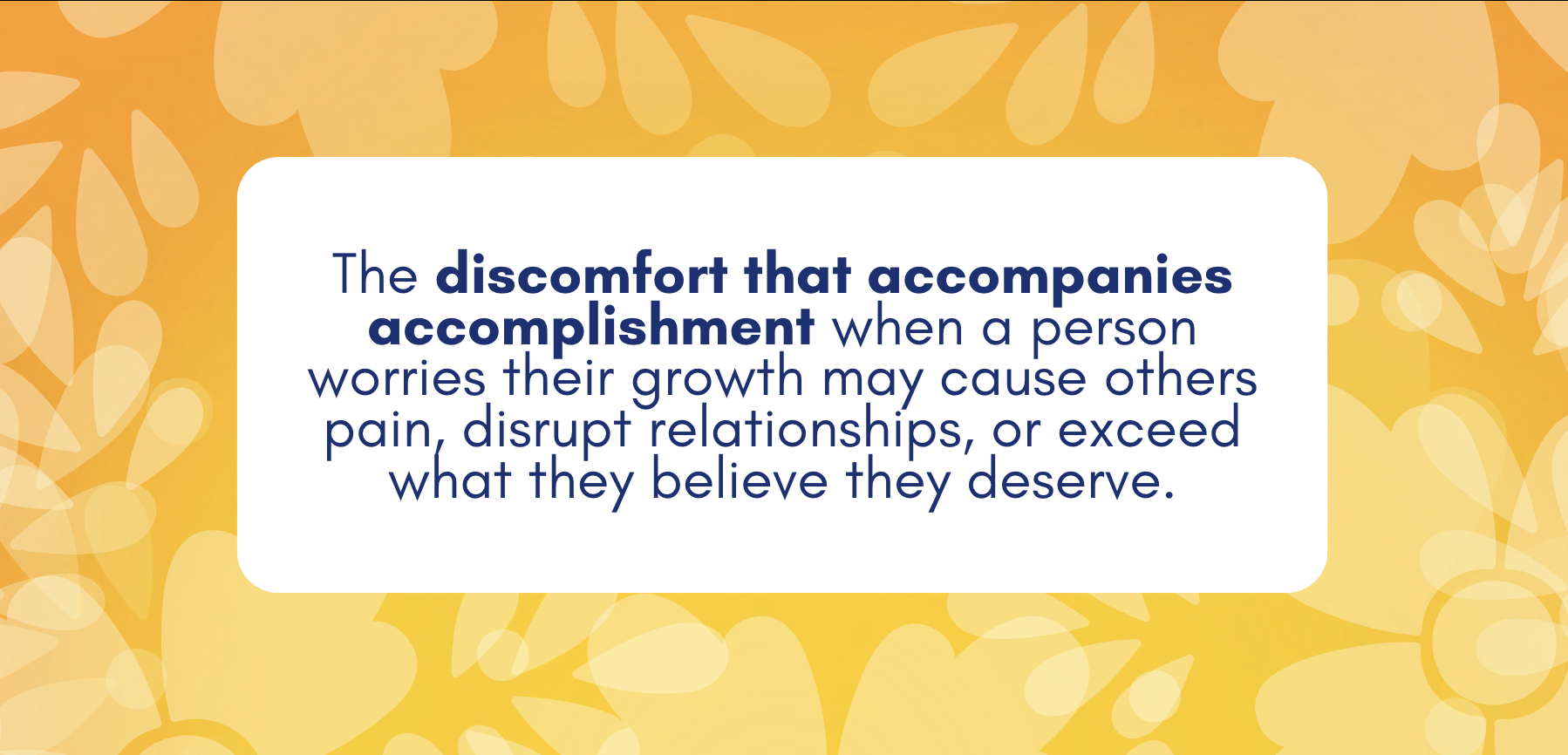
As a woman in STEM, I felt undeserving of this monumental achievement. Although I had surpassed their level of education, I hadn’t endured their exact hardships.
Inheriting a Legacy of Resilience
It wasn’t until turning nine that I truly understood that my grandma barely knew how to spell her own name.In 1900, almost 80% of Mexican women over age ten were illiterate.
My mother began middle school in Mexico and transitioned to high school in Texas. My father chose to work in Mexico over continuing his education. In 1990, my parents couldn’t join the 38% of Hispanic immigrants in the U.S. completing their high school education because making the transition to a new country demanded their full attention. This unfamiliar environment brought countless challenges, including:
homesickness
language barriers
culture shock
racism and discrimination
This was the perfect recipe for defeat, yet they endured! When asked what fueled them, their response was clear: “It was for the next generation.” They crossed deserts, rivers, and political borders so that I could have a better chance at crossing the graduation stage.
How could anything I accomplish compete with that?

Photo: Maria, Dayna’s mother, at her high school graduation walking the stage but not receiving her high school diploma (1992). She returned to school and successfully earned her GED in 2008.
Success Guilt Isn’t New
Experiences of success-related guilt are not new.Freud himself described a similar feeling in his 1936open letter to Romain Rolland, when he felt guilty for visiting the Acropolis in Athens, perceiving it as an act of “disloyalty to his parents.”
This guilt can stem from:
folks leaving family behind,
gaining privileges,
growing or becoming different,
having access to opportunities,
or feeling pressure to succeed.
For me, this feeling was deeply intertwined with an old, familiar friend: imposter syndrome, which made frequent appearances throughout my college career.

Photo: Dayna and her mother celebrating Dayna’s first birthday (2000).
My Realization
As I explored this feeling, I realized that my success guilt emerged from the belief that the people before me didn’t have it this easy. However, the journey for me hadn’t been easy either.
I needed to accept and validate my own journey because my path was not separate from theirs– it was simply an extension. Every struggle is relative to circumstance, and I made the mistake of devaluing my own hardships by comparing them to others’, a tendency that also extended to my achievements, measuring them against those around me.
Curbing First-Generation Success Guilt
When success guilt goes unaddressed, it can even lead students to carrying behaviors that are submissive, self-sabotaging, and ultimately preventing them from reaching their personal and professional potential.
So, What Can You Learn from Me?
For folks experiencing similar journeys, your success can carry both gratitude and guilt. So, give yourself grace.Your struggles are absolutely valid, and I want to remind you of the following:
Everyone’s starting point and finish line are different. I had been naively seeing life as a race, when in reality it is a relay. My parents passed the baton to me, just as my grandparents had passed it down to them, each generation covering new ground along the way, and moving forward.
In collectivist cultures, successes are shared. After much recalibrating and unlearning, I realized that my family struggled before me, to run alongside me, to walk that graduation stage with me.
Recognize that your success reflects their investment in you, it’s not betrayal. In fact, betrayal would be failing to make the most of what they gave you.
Processing this guilt can be essential to reaching future goals, and allowing yourself to fully accept these achievements is a way to honor your hard work and the lineage that made it possible.

Photo: Dayna at the Houston Botanic Gardens for her college graduation pictures (2021).
Further Reading:
Cloyd, M. C. “Family Achievement Guilt as Experienced by First-Generation College Students: A Phenomenology.” Liberty University. April 2019.
Covarrubias, R., et al. “Developing a Family Achievement Guilt Scale Grounded in First-Generation College Student Voices.” Pers Soc Psychol Bull., 14 Mar. 2020.
Wood, Kamini. “What Is Success Guilt (& How Do You Overcome It)?”Kamimi Wood, 19 May. 2025.
Eldridge, Stephen. “Imposter Syndrome.” Encyclopædia Britannica, 24 Jan. 2026.
Fimiani, R., et al. “Guilt over success, impostor phenomenon, and self-sabotaging behaviors.” Curr Psychol, 17 Feb. 2024.
Freud, Sigmund. “A Disturbance of Memory on the Acropolis.” The Standard Edition of the Complete Psychological Works of Sigmund Freud, 1936.
Gutierrez F. J. “Poblacion y educacion. Algunos retos actuales [Population and education: some current challenges].” Demos. 1992
Lamia, M. C. “The Downside of Success: Guilt or Shame?” Psychology Today, 12 Jun. 2011.
Noé-Bustamante, L. “Education levels of recent Latino immigrants in the U.S. reached new highs as of 2018.” Pew Research Center, 7 Apr. 2020.
O'Connor, L. E., et al. “Survivor guilt, submissive behaviour and evolutionary theory: The down-side of winning in social comparison.” British Journal of Medical Psychology, 14 Feb. 2011.
Resnick, Arian. “What to Do If You Feel Guilty About Success.”Verywell Mind, 25 Jan. 2026.
St. Thomas University. “Toolkit for First-generation Graduate Students.” St. Thomas University, 5 Jan. 2026.
“The Posse Foundation.” Posse Foundation